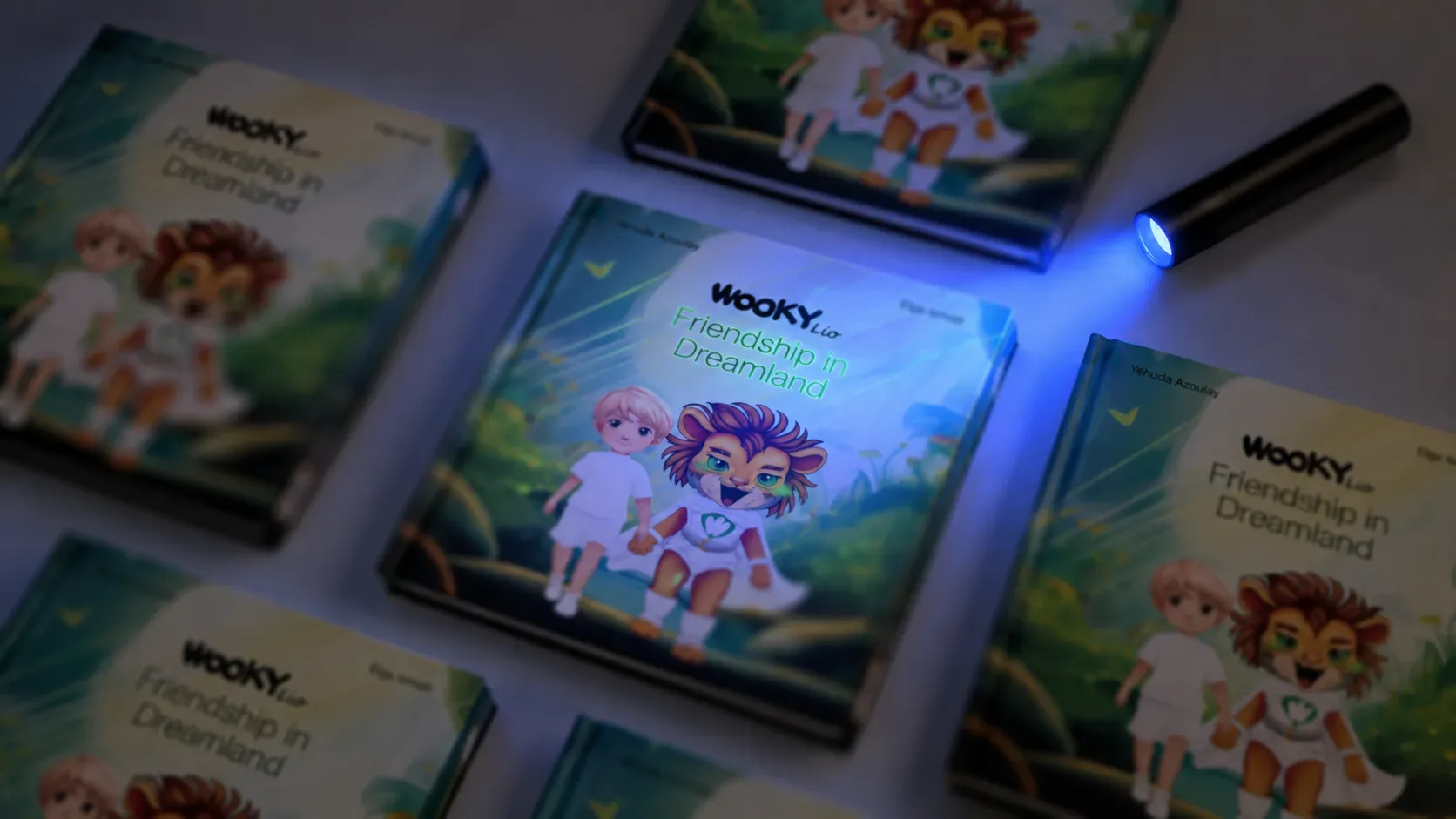
An ultraviolet flashlight can do something a regular flashlight cannot.
When it shines on certain colors and materials, details that were barely visible before can suddenly appear. Illustrations gain another layer, hidden elements are revealed, and the child changes from a reader looking at a book into someone actively exploring it.
For children, the feeling can seem almost magical.
And for parents, a natural question also comes up: is a UV flashlight safe for children?
As with many products we bring into the home, the answer begins with understanding the product and using it correctly.
Not every UV source is the same. There are different types of ultraviolet radiation, different wavelengths and different intensities.
In the case of the flashlight included with WOOKY Lio: Friendship in Dreamland, we know exactly what type of flashlight it is: a UVA LED flashlight with a wavelength of 365 nanometers and a declared LED source power of 3W, designed to reveal the special colors and details printed in the book.
It is not a UVC disinfection lamp and it is not a tanning lamp.
It is a small flashlight designed to perform one very specific task - illuminate the pages of the book and reveal what is hidden in them.
What is ultraviolet light?
The light we can see is only one part of the electromagnetic spectrum.
Next to the violet end of visible light lies the range of ultraviolet radiation - Ultraviolet, or UV for short.
The human eye cannot see most of this radiation, but some materials react to it and emit visible light.
This phenomenon is called fluorescence.
That is why a UV flashlight can make certain colors and markings glow and turn details that are barely visible under ordinary lighting into something clear and surprising.
We encounter the same phenomenon in many areas of everyday life:
- Checking banknotes
- Security markings
- Art and exhibitions
- Various inspections
- Fluorescent colors
- Attractions and games
- Special printing
- And, of course, interactive books
UVA, UVB and UVC - not all UV is the same
One reason the term UV sometimes sounds more alarming than it needs to is that it describes a broad range of wavelengths.
The range is commonly divided into three main groups:
UVA
UVA has longer wavelengths and lower energy than UVB and UVC. The UV flashlight included with WOOKY Lio: Friendship in Dreamland operates in this range, at a wavelength of 365nm.
UVB
UVB has a shorter wavelength and higher energy. We know it mainly as part of sunlight, and it is largely responsible for sunburn.
UVC
UVC has even shorter wavelengths and is used, among other things, in dedicated disinfection systems.
It is important to understand that a UVC disinfection lamp and a 365nm UVA flashlight designed to activate fluorescent printing are very different products.
There is therefore no reason to treat everything labeled UV as though it were the same light source.
What flashlight exactly comes with the book?
The flashlight supplied with WOOKY Lio: Friendship in Dreamland is:
- A UVA flashlight
- Wavelength: 365nm
- Light source: LED
- Declared LED power: 3W
- Recommended illumination distance in the specification: 10-15 meters
- Built-in lithium battery
- USB charging
- Designed to activate the special effects in the book
These details matter because they allow us to know that this is not a UVC disinfection lamp or another industrial product.
At the same time, the 3W figure describes the LED source and by itself is not a measurement of how much UVA radiation reaches the eye or skin. That is why correct use of the flashlight remains very simple:
Use it for the purpose for which it was designed - illuminating the pages of the book.
So, is a UV flashlight safe for children?
When it is used according to its intended purpose and the product instructions, there is no need to turn the flashlight into something frightening.
It is a small UVA flashlight designed to illuminate the book for short periods during reading.
As with a regular flashlight, it is worth teaching the child one simple rule: shine it on the book, not into the eyes.
This is a sensible rule of use that can be taught in exactly the same way we teach a child not to point an ordinary LED flashlight at someone's eyes.
The fact that the flashlight uses UV does not need to make reading feel worrying.
It simply requires correct use.
What about comparing it with a regular flashlight?
Here it is important to be precise.
A regular flashlight and a UVA flashlight do not create exactly the same type of exposure, so it is not scientifically meaningful to make a simple statement that one is always more dangerous than the other.
A strong ordinary LED flashlight can produce intense, dazzling visible light, which is why it too should not be pointed directly into the eyes.
The UVA flashlight supplied with the book operates at 365nm and is intended for localized illumination of the pages.
In terms of the behavior we want to teach the child, the rule is the same: do not point a regular flashlight into the eyes, and do not point the UV flashlight into the eyes.
In practice, there is no reason to do so during reading. The flashlight is aimed downward at the book, exactly where it is supposed to be.
Why do we tell children not to point any flashlight at the eyes?
We teach children not to point light sources at the eyes long before they ever encounter a UV flashlight.
A regular LED flashlight can be very bright and cause glare and discomfort when looked at directly.
With UVA there is another reason to follow the rule: much of the radiation is not visible to the eye, so the subjective feeling of how bright the light seems is not enough to judge exposure.
This is not a reason to be afraid of the flashlight.
It is simply a reason to use it in the way it was designed to be used.
Instead of pointing it at faces, point it at the book.
What about children ages 3-7?
WOOKY Lio: Friendship in Dreamland is designed for children ages 3-7, so the reading experience was designed from the beginning as something the child and adult can do together.
At these ages, it is recommended that a parent or another adult be part of the use of the flashlight.
But there is another advantage here:
The adult is not beside the child only to supervise the flashlight.
They are there to read, ask, discover, laugh and be part of the experience.
A simple rule like "shine it on the book" quickly becomes a natural habit.
Perspective matters - our homes are already full of products that require care
When we hear the word UV, it is easy to focus on it and forget that children are surrounded every day by dozens of products that require rules of use.
In an average home you may find:
- Scissors
- Kitchen knives
- A kettle with boiling water
- Ovens and stovetops
- Electrical sockets and cables
- Medicines
- Cleaning products
- Small batteries
- Tools
- Hair dryers
- Candles
- Toys with small parts
With some of these products, incorrect use can create significantly greater risk than short, intended use of a small UVA flashlight.
And yet we do not remove every object that requires care from the home.
We teach children how to use things.
We keep products that are unsuitable for their age away from them.
And with products that are suitable for shared use, we stay beside them.
The same logic applies here.
The UV flashlight is not intended to be a toy that is pointed around the room.
It is a small tool inside the reading experience.
You turn it on, illuminate the page, discover the magic and turn it off.
What about the sun?
Here too, perspective can help.
The main source of UV to which all of us are exposed in everyday life is actually the sun.
Children play outside, go to preschool, take walks, visit the beach and spend periods in sunlight that are much longer than the minutes during which a flashlight is used while reading.
This is not a reason to ignore artificial UV sources, but it does illustrate why we need to think in terms of the type of radiation, intensity, duration of exposure and manner of use, rather than reacting only to the term UV.
6 simple rules for using a UV flashlight with children
1. Shine it on the book
That is what the flashlight is designed for, and it is also where the effect works best.
2. Do not point it at the eyes
Exactly as you would not point a regular LED flashlight at the eyes.
3. With younger children, read together
For children ages 3-7, it is recommended to use the flashlight as part of shared reading with an adult.
4. Use the flashlight supplied with the book
The flashlight was selected to work with the book's special printing. There is no need to replace it with another, more powerful UV flashlight.
5. Do not use UVC flashlights
UVC disinfection lamps are a different category and are not intended for the reading experience.
6. When reading is finished, switch it off
The flashlight is part of the reading ritual, not a permanent light source in the room.
Why put a UV flashlight inside a children's book at all?
Because it changes the relationship between the child and the book.
In a regular book, the child sees the illustration the illustrator decided to show.
In an interactive book with UV-reactive colors, there is another layer.
Something can be there - without the child seeing it immediately.
To find it, the child has to do something.
Shine. Search. Discover.
Suddenly, reading gains a playful dimension.
The child is not only a reader - they become an explorer
Children love discovering things for themselves.
When a child holds the flashlight and moves it across the page, they begin to ask:
What is hiding here? Is there something behind the character? What happens if I shine the light in the corner? Maybe I missed something on the previous page?
And that creates something that is difficult to achieve in a regular book: a reason to go back.
The child is not rushing only to reach the end. They want to explore the world.
365nm - why this wavelength?
A 365nm flashlight is in the UVA range and is especially suitable for activating certain fluorescent materials and inks.
When the light hits the special colors in the book, they react and emit visible light.
The result is the feeling that the illustration itself begins to glow.
This is not projection. There is no screen. No app. No phone is needed.
The effect exists inside the printed book itself.
An interactive book without a screen
One of the interesting things about this experience is that it uses technology without turning the book into a digital product.
The child still holds a real book. Still turns pages. The parent still reads aloud. The illustrations are still printed.
But a small technological layer is added that allows the child to be active inside the story.
It is a way to create interactivity without adding another screen to the daily routine.
WOOKY Lio: Friendship in Dreamland - when light becomes part of the story
WOOKY Lio: Friendship in Dreamland was created from a desire to turn story time into an experience children will want to return to.
The book is designed for children ages 3-7 and combines story, illustrations and special UV-reactive colors.
The flashlight included with the book is a 365nm UVA flashlight.
When the child shines it on the pages, details and layers printed in the special inks are revealed.
The flashlight is not a gimmick disconnected from the book.
It is part of the story.
The child needs to use it in order to find the things the book is hiding.
A small parent-and-child moment
We can talk a lot about technology, wavelengths and special printing.
But ultimately, one of the most important things about a children's book is what happens around it.
A parent and child sit together. Open the book. Read. Dim the light a little. The child takes the flashlight. And suddenly something appears.
The child says: "Look!"
And that may be the truly important moment.
Not the UV. Not the LED. Not the printing.
But the shared moment created between them.
Can you use any UV flashlight?
It is better not to.
The fact that two products are both labeled UV does not mean they are identical.
They can differ in wavelength, intensity, optics and intended use.
The book comes with a 365nm UVA flashlight selected for its printed effects, so there is no need to use another UV flashlight.
And UVC sources intended for disinfection should certainly not be used.
Further reading
To explore the subject further, you may also enjoy our article about children's books with a UV flashlight, our guide to interactive children's books, our article about bedtime story time, and our article about screen-free activities.
Frequently asked questions about UV flashlight safety for children
Is a UV flashlight safe for children?
When it is a UVA flashlight intended for the product and it is used according to the instructions, it can be treated like other products that require simple rules of use. For children ages 3-7, we recommend using it as part of shared reading with an adult and not pointing it at the eyes.
What flashlight comes with WOOKY Lio: Friendship in Dreamland?
The book comes with a UVA LED flashlight at a wavelength of 365nm. According to the manufacturer's specification, the LED source has a declared power of 3W, and the flashlight includes an internal lithium battery and USB charging.
Is a 365nm flashlight UVC?
No. 365nm is in the UVA range. UVC disinfection lamps operate in a different range and are not intended for use with the book.
Can the flashlight be pointed at the eyes?
No flashlight should be pointed directly into the eyes. The same simple rule applies here - a regular flashlight illuminates what you want to see, and the UV flashlight illuminates the pages of the book.
Is a UV flashlight more dangerous than a regular flashlight?
It is not possible to compare all UV flashlights with all regular flashlights in one blanket statement. Risk depends on intensity, wavelength, distance and duration of exposure. A strong regular LED flashlight can also create significant glare when directed at the eyes. In practical use with a child, the rule is therefore the same for both: do not point the light at the eyes.
Should parents be afraid of the term UV?
No. It should be understood. UV is a broad range of radiation that includes UVA, UVB and UVC. The flashlight supplied with the book is a 365nm UVA flashlight intended to activate the fluorescent effect of the printing.
Can children hold the flashlight themselves?
For ages 3-7, we recommend that use be part of shared reading with an adult. The child can be the one searching for details on the pages according to the instructions and the rules established by the adult.
In conclusion
When children are involved, it is good to ask questions.
It is good to check what the product is.
And it is good to establish rules for use.
But it is also important to keep things in perspective.
The flashlight included with WOOKY Lio: Friendship in Dreamland is not a UVC disinfection source and is not a tanning lamp. It is a small 365nm UVA flashlight based on an LED with a declared power of 3W, designed for one clear purpose - revealing the special printing on the pages of the book.
Just as we teach a child not to point a regular flashlight at the eyes, we teach them not to point the UV flashlight at the eyes.
Just as we teach them to use scissors, electrical appliances and other household objects according to their purpose, here too a few simple rules are enough to turn caution into a natural habit.
And then we can return to the reason the flashlight is there in the first place.
Open the book. Dim the lights a little. Shine on the page. And discover together something that could not be seen a moment before.
Discover WOOKY
Meet WOOKY Lio: Friendship in Dreamland
An interactive children's book for ages 3-7 with a UV flashlight, inviting children and grown-ups to read, shine, discover and experience the story together.
Explore WOOKY