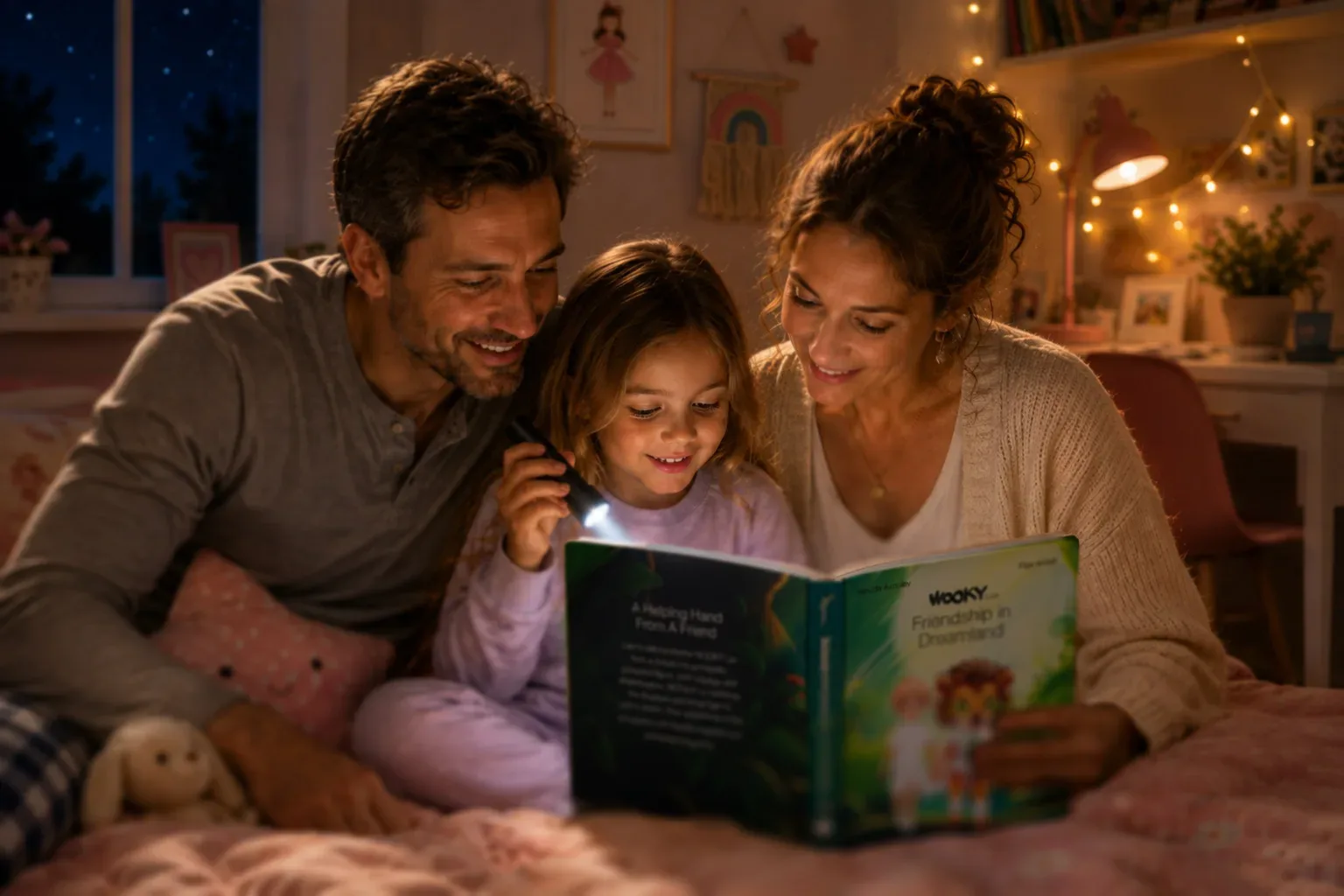
At the end of a busy day, when toys are still on the floor, thoughts are racing and children are still full of stories from everything that happened, there comes a moment when the house begins to change pace. The lights dim, voices grow quieter, and the family moves closer to bedtime.
For many families, this moment becomes one of the closest parts of the day: bedtime story time. There is no screen demanding attention, no need to complete another task, and there are a few minutes in which a child and an adult are together around the same book.
A good bedtime story does not have to be long, elaborate or perfect. It can be ten minutes of reading at the edge of the bed, a familiar story that has already been told dozens of times, or an interactive book that invites the child to participate. What makes it meaningful is mainly repetition, closeness and the feeling that this is time that belongs to the family.
In this article, we will look at how to build a bedtime story routine for children ages 3-7, how to choose the right book for that particular evening, what to do when a child finds it difficult to settle down, and how to make reading a natural part of the evening routine.
Why is bedtime story time so important?
Throughout the day, children move between preschool or school, play, noise, encounters, tasks and stimulation. The transition from all of that to sleep does not always happen in a single moment. Story time can serve as a clear middle station: the day is ending, the pace is slowing, and now it is time for something quieter.
The value of this time does not come only from the book. It comes from the ritual built around it. The child knows what to expect: after the bath, they get into bed, choose a book, read together and then say good night. Repetition creates a familiar framework and reduces the need to renegotiate the end of the day every evening.
There is also a simple emotional value. After a day when parent and child have not always been together, reading brings them back to the same physical and emotional place. The child can ask a question, share something that happened or simply listen to a familiar voice.
Even when the child already knows the book by heart, the moment itself remains new. One evening they laugh at a different sentence, another evening they linger over an illustration, and another time they surprise you with a question they have never asked before.
Bedtime story time is not just another activity. It can become a family ritual children remember years later.
How do you create an evening routine that slows the pace?
An evening routine does not have to be a military schedule. The goal is to create a familiar sequence of actions that signals to the child that the day is coming to an end. When the same steps repeat in roughly the same order, there is less room for negotiation around every action.
For example, a family might choose a simple sequence:
- Dinner.
- Bath and getting ready.
- Brushing teeth.
- Dimming the lights in the room.
- Choosing a book.
- Reading together.
- A hug and good night.
The exact order matters less than consistency. Some families read before brushing teeth, while in others the book is the very last activity. Choose a sequence that suits your family's actual life rather than trying to copy a ritual that is not practical for you.
You can also give the child a sense of choice within the framework. For example, the adult decides that it is reading time, and the child chooses between two books. The boundary stays clear, while the child still feels involved.
On busy or late evenings, the ritual can be shortened without giving it up completely. Even a short story or a few pages can preserve the sense of continuity.
Why are books especially well suited to the moment before sleep?
A printed book offers a different pace from much of the rest of the day. There is no automatic transition, notification, scrolling or next video. The child and adult decide when to turn the page, when to pause and when to go back.
The action itself is simple: you sit close, look in the same direction and listen to the same story. Precisely because of that simplicity, conversation can arise naturally. A child can stop and ask why a character is afraid, what is hiding in an illustration or what will happen on the next page.
A book also allows imagination to work without overload. The illustration offers a world, and the child fills it with voices, movement and sensations. When the story is familiar, the child can already participate, complete sentences and feel that they are part of the reading.
For ages 3-7, you can choose books with a clear plot, relatable characters and illustrations that give children a reason to look closely. Not every book has to be "sleepy." A funny or adventurous story can work too, as long as the reading pace and surrounding atmosphere are pleasant.
The benefits of reading together before bed
Language and vocabulary
Books introduce children to words and expressions that do not always appear in everyday conversation. Repeated reading of familiar books gradually allows those words to become part of the child's own language.
Imagination and thinking
A story invites the child to imagine a place, understand what a character may be thinking and guess what will happen next. Even when there is no single correct answer, the conversation itself encourages thinking.
Listening and concentration
Reading creates a period in which the child follows a sequence. At a young age they may get up, ask questions or return to a previous page, and that is fine. Over time, the ability to stay within a longer story develops.
Connection with the parent
Perhaps the most important benefit cannot be measured. A few minutes in which the parent is doing nothing else but reading and listening gives the child a sense of presence. It is time in which conversation is not competing with other tasks.
A sense of continuity and security
A ritual that repeats every evening creates a familiar expectation. The child knows what comes now and what comes afterward. In a world where many things change during the day, this small sequence can feel especially comforting.
How do you choose a book for bedtime story time?
Not every book that suits the child's age necessarily suits every evening. It is worth thinking about mood, level of tiredness and how much time you truly have.
Choose a book that fits the length of the evening
If the child is already very tired, a short book may be better than a long one that creates a struggle halfway through. On a calmer evening, you can choose a more complex story.
Prefer a book that is pleasant to read aloud
Rhythm, language and repetition are especially important during shared reading. When the adult enjoys the text, the child feels it too.
Make room for familiar books
There is no need to introduce something new every evening. Many children ask for the same story again and again. Familiarity allows them to anticipate what is coming, participate and discover additional details.
Look for illustrations that invite observation
Sometimes an entire conversation begins with one small detail in an illustration. Visually rich books create room for searching and questions without adding more text.
Match the level of interactivity
One evening the child may happily search, guess and participate. Another evening they may prefer simply to listen. Even an interactive book can be read at a calm pace without activating every possible feature every time.
How do you make story time something children look forward to?
The magic does not require a production. In fact, the simpler the ritual, the easier it is to maintain over time.
- Choose a regular, comfortable place for reading.
- Let the child choose the book from a small selection.
- Put the phone out of reach during reading.
- Use different voices for characters if that feels natural to you.
- Allow the child to stop and point to illustrations.
- Do not rush to finish just to reach the final page.
- End with the same sentence or hug if it becomes part of the ritual.
You can also create a small tradition of a "night question": after the book, each person says what their favorite moment in the story was, or what they think will happen to the character tomorrow. This small action connects reading with conversation.
What should you do when the child has trouble settling down for sleep?
There are evenings when no sequence works exactly as planned. The child is full of energy, does not want to stop playing, asks for more water or gets up again and again. In situations like these, it is important not to turn the book into another arena for conflict.
You can begin the transition earlier, gradually reduce the level of activity at home and offer a clear choice: "Do you want this book or this book?" rather than asking an open question about whether the child wants to go to bed at all.
If the child cannot concentrate on a long story, choose a few pages, look at the illustrations together or tell a story orally. The goal is to preserve as calm a transition as possible, not to complete a reading quota.
It is also important to recognize when the child is simply too tired. Sometimes it is better to skip another activity and end the evening with a short hug and quiet.
What should you do when the child asks for more and more stories?
Asking for another story can be a wonderful compliment to the ritual you have built, but it can also stretch the evening endlessly. The simplest approach is to set a clear framework in advance.
You can say at the beginning: "Tonight we are choosing two short books" or "We are reading this book and then it is time for good night." When the boundary is known in advance, it is easier to keep it without turning the final book into a negotiation.
If the child still asks for more, you can offer a one-minute story told aloud or choose together which book will wait for tomorrow. This preserves the excitement without reopening the whole bedtime routine.
An interactive book as part of bedtime story time
An interactive book can fit beautifully into the evening when the interaction does not turn reading into a high-energy activity. Searching for details, questions, discoveries in an illustration or an action with a flashlight can deepen curiosity and give the child a role.
The key is pace. There is no need to use every option during every reading. You can choose one page to search, let the child illuminate a few details and then return to the story. The fact that you do not discover everything in one evening can actually create a reason to return the next day.
Children ages 3-7 especially enjoy the feeling that they know something the adult has not yet discovered: where a detail is hiding, what will happen on the next page or which additional layer will appear.
WOOKY Lio: Friendship in Dreamland - when light becomes part of the evening ritual
WOOKY Lio: Friendship in Dreamland is designed for children ages 3-7 and combines story, rich illustrations and interactive discovery using the UV flashlight included in the set.
The combination is especially well suited to the moment before sleep because the reading begins as a regular book, and then the child can use the flashlight to discover additional layers and details within the illustrations. The adult reads, the child shines the light, and together they explore the world of the story.
The flashlight does not need to take over the reading. Each evening you can choose only a few areas to explore, ask what the child thinks may be hiding there and let the story continue at its own pace.
In this way, the book can change from text that is simply read aloud into a recurring family activity: one time focusing on the plot, another time on hidden details, and another time inventing together what else might happen in Dreamland.
Mistakes worth avoiding during bedtime story time
Starting too late
When a child is already exhausted, even a beloved story can become a task. It is better to begin the evening routine before reaching the edge of tiredness.
Turning reading into a test
Not every page needs a question about a color, number or word. Conversation can be open, funny and imaginative.
Insisting on finishing every book
It is okay to stop in the middle. The book will still be there tomorrow.
Choosing only books with a message
At bedtime, it is also fine to read a story that is simply funny or intriguing. Not every evening has to end with a lesson.
Using the phone during reading
Even a quick look at a screen changes the feeling of presence. If possible, put it aside for a few minutes.
Trying to create a perfect evening
A good routine needs to survive busy days too. A short ritual that can be maintained most evenings is better than a complicated plan that is abandoned after a week.
A small tip for parents: create a regular signal that story time is beginning
Children respond well to repeating signals. It can be dimming a lamp, placing the flashlight beside the book, choosing a special cushion or using a regular sentence such as "Now our story begins."
The signal is not magic in itself, but over time it becomes part of the familiar sequence. Instead of beginning a negotiation from scratch every evening, the repeated action reminds the child what comes next.
There is no need to add more and more steps. Choose one signal that is easy to maintain even when you are tired or in a hurry.
Further reading
To explore the subject further, you may also enjoy our article about story time and the shared reading experience, our guide to interactive children's books, our article about books for young children, our article about screen-free activities, our article about imaginative play, and our guide to choosing gifts for kids.
Frequently asked questions about bedtime story time
How long should bedtime story time last?
There is no fixed amount. For many families, 10-20 minutes is comfortable, but it is better to match the length to the child's age, attention span and level of tiredness.
What time should a bedtime story be read?
It helps to place the story at a relatively fixed point in the evening routine, after the main activities have ended and before saying good night.
Do you need a new book every evening?
No. Many children love returning to a familiar book again and again. Repetition allows them to participate and discover new details.
What if the child does not want to listen to a story?
Choose a shorter book, look only at the illustrations, let the child choose the book, or try again another evening. Reading should not become a struggle.
What if the child keeps asking for more stories?
Set a clear framework in advance, such as one long book or two short books, and keep it consistently and pleasantly.
Is an interactive book suitable before bed?
Yes, as long as the interactivity remains part of a calm reading experience and does not become too stimulating.
Do you have to read in bed?
No. You can read in an armchair, a reading corner or on a rug. The important thing is that the place is comfortable and relatively quiet.
What ages is WOOKY Lio: Friendship in Dreamland designed for?
The book is designed for children ages 3-7 and combines story, illustrations and interactive discovery using a UV flashlight.
In conclusion
Bedtime story time does not need to be a perfect ritual in order to be meaningful. It can be short, change from one evening to the next and sometimes even end in the middle of the book. What gives it power is the fact that it returns and gives the child a clear transition from day to night.
For children ages 3-7, reading can also be a time for conversation, imagination and discovery. Children do not have to sit silently and listen to every word. They can ask, guess, point, laugh and complete sentences. Their participation is part of the experience.
A good bedtime book is not measured only by how quickly the child falls asleep afterward. It is also measured by the moment created during reading: the parent's voice, the question the child felt safe enough to ask, the small detail in an illustration they discovered together and the feeling that there are a few minutes each day when nothing else is urgent.
When building an evening routine, it is worth starting with things you can maintain over time. A comfortable place, a choice between a few books, a short period without a phone and a clear ending are often all that is needed. The simpler the ritual, the easier it is to turn it into a habit.
An interactive book can add another layer to story time when it is used at a pace that suits the evening. A search, a question or a discovery with a flashlight can turn the child from listener into partner without giving up the intimacy and calm of reading.
Ultimately, children will not necessarily remember how many books you read or exactly what time you turned off the light. But they may remember the feeling: that someone sat beside them, read with them, listened to them and opened a door with them into another world just before the day ended.
Discover WOOKY
Meet WOOKY Lio: Friendship in Dreamland
An interactive children's book for ages 3-7 with a UV flashlight, inviting children and grown-ups to read, shine, discover and experience the story together.
Explore WOOKY