Interactive children's books change the way children encounter a story. Instead of sitting only as listeners and waiting for the adult to finish reading the page, they are invited to search, choose, guess, touch, shine a light, ask questions and participate.
Sometimes the interaction is very simple. The child looks for a character hidden in an illustration, completes a word that repeats throughout the story or guesses what will happen on the next page. In other books, they open flaps, move parts, activate sounds or reveal hidden layers that cannot be seen at first glance.
What all of these books have in common is a small but meaningful change: the child does not remain outside the story. The book gives them a role. Even when the plot is already familiar, the way they participate can change. One time the child searches for details, another time they invent a different ending, another time they tell the story themselves, and another time they discover something in the illustration that the adult did not notice at all.
In a world where children are used to fast stimulation from screens, an interactive book offers a different kind of interest. It does not hurry the child and does not decide when to move to the next piece of content. The child and adult control the pace, can stop, go back and stay a little longer with a page that sparked a question or a smile.
What is an interactive children's book?
An interactive children's book is a book that invites the child to perform an action as part of the reading experience. The action can be physical, mental, emotional or creative. It does not have to involve a complex mechanism or technology. Sometimes one smart question inside the story is enough to turn a child from a passive listener into an active participant.
In an interactive book, the child may:
- Search for a character or detail hidden in the illustration.
- Guess what will happen next.
- Choose between different options.
- Complete a word, sentence or sound.
- Open flaps or move parts on the page.
- Imitate a movement made by one of the characters.
- Shine a light on the page and reveal hidden details.
- Invent dialogue or a new continuation to the plot.
- Answer questions about the characters' feelings.
- Retell the story in their own words.
The most important definition is not about a particular accessory, but about the way the book relates to the child. An interactive book does not only say, "Listen to me." It says, "Let's do this together."
A good interactive book does not replace the story with activity. It uses activity to draw the child deeper into the story.
Why do children connect so strongly with interactive books?
Children learn about the world through action. They touch, ask, try, repeat and look for connections between what they see and what they already know. When reading allows them to act, it speaks their natural language.
Instead of asking a young child to stay quiet through the entire story, the book allows them to express their curiosity as part of the experience. They can point, guess, laugh, ask questions and ask to return to a certain page.
Participation also creates a sense of ownership. The child does not feel that the story belongs only to the person reading it aloud. Their choices, answers and ideas become part of what happens during the reading.
This is one reason children may ask to read an interactive book again even when they already know it. They do not return only to hear the plot again, but to experience it in a slightly different way. The first time they focus on the characters, the second time they search for hidden details, and the third time they may already try to tell what is going to happen themselves.
Interactivity does not have to be digital
When we hear the word "interactive," it is easy to think immediately of a screen, app or digital game. But a children's book can be highly interactive without a battery, internet connection or electronic buttons.
In fact, some of the most meaningful interactions are created between the child and the adult, not between the child and a device. A question such as "What do you think the character is feeling now?" can open an entire conversation. Asking the child to find three stars hidden in the illustration can turn the page into a search game. Inviting them to invent a new name for a character gives the child room to bring their own world into the story.
Good interactivity is not measured by the number of effects. It is measured by the level of involvement it manages to create. Sometimes a book with very few explicit instructions leaves more room for imagination. The child is not given a ready-made answer, but is invited to think, create and tell.
What kinds of interactive children's books are there?
The world of interactive children's books is very diverse. Each type creates participation in a different way and suits different ages, interests and reading moments.
Search-and-discover books
In these books, the child searches for characters, objects, colors or details hidden inside the illustrations. Searching encourages observation and allows the child to move at their own pace. Even after they know the plot, they can return to the illustrations and find new details.
Books with flaps and moving parts
Opening a flap, pulling a tab or turning a wheel creates a clear moment of action and discovery. Books like these are especially suitable for young children who enjoy the direct connection between action and result. It is important to choose a book with strong, safe mechanisms designed for repeated use.
Books that invite movement and sound
Some books ask the child to clap, blow, whisper, roar like a lion or imitate a character's movement. Reading becomes a physical and playful activity, which can be especially suitable for children who find it difficult to sit for a long time and listen without moving.
Books with questions and choices
In books of this kind, the child is asked to guess, choose or express an opinion. There is not always one correct answer. The goal is to encourage conversation, thinking and personal expression.
Books with textures, materials and sounds
Touch-and-feel books allow children to explore different surfaces and textures as part of the story. Sound books add music, an animal sound or a line from the plot. When the texture or sound is integrated precisely, it enriches the experience rather than distracting from it.
Books that reveal hidden layers
In these books, the page contains more than what can be seen in normal light or at first glance. Additional details are revealed through a special action, such as shining the appropriate light. The discovery is not outside the book; it is printed into the page itself. The familiar image changes before the child's eyes and invites them to keep checking what is hidden inside it.
What can interactive books add to the reading experience?
The first goal of a children's book is to create a good reading experience. Interactivity should not feel like a lesson or a test, but should add interest, enjoyment and connection.
Active participation
The child is not required to remain only in the role of listener. They get an opportunity to influence the pace and choose what to focus on.
Curiosity and observation
A hidden detail, open question or change that happens after an action makes the child want to discover what happens next. Searching also encourages close looking rather than rushing to the next page.
Shared conversation
An interactive book gives the adult natural reasons to pause and talk with the child. The conversation can begin with the story and continue into a personal experience, emotion or memory.
Repeated reading
When a book contains details to search for or different ways to participate, the second reading does not have to be the same as the first. Each encounter can focus on something different.
Confidence and personal expression
Young children who do not yet read can still feel that they contribute to the reading. They identify, search, complete and tell in their own words. In this way, the child also has a voice and a role.
The real connection is created between the child and the adult
We can talk about mechanisms, illustrations, flashlights and flaps, but the most important interaction during reading is not inside the book. It happens between the child and the person sitting beside them.
The child points to something and the adult responds. They ask a question and the adult listens. They invent an idea and the adult continues it. These exchanges turn reading into conversation rather than one-way narration.
An interactive book can create many opportunities for moments like these, but it does not do the work by itself. The magic happens when the adult does not rush to provide all the answers, but leaves the child room to look, think and lead.
How do you choose an interactive children's book that truly fits?
Not every interactive book suits every child. The right choice begins with the story and the child, not with the number of mechanisms advertised on the cover.
Check whether the story stands on its own
The interaction should enrich the plot rather than hide the fact that the book lacks substance. Ask yourself: Would the book still be interesting without the effect? Do the characters create emotion? Is there a reason to want to know what happens next?
Match the level of activity to the child's age
A toddler may enjoy a clear, simple action such as opening a flap. An older child may look for a puzzle, choice or detail that requires closer observation. Instructions that are too complex can interrupt the story, while actions that are too simple may quickly lose the interest of older children.
Look for interaction that remains interesting
Some effects surprise only once. After the child knows what is hidden behind them, there may be little reason to return. A good book allows reading to change. The child can find new details, offer different answers or use the same action in a new way.
Check the physical quality
Interactive books are opened, closed and operated many times. A strong cover, quality pages and clear printing matter especially when the book is intended for young children.
Prefer participation over overload
More buttons, sounds or actions do not necessarily mean a better book. The mechanism should serve the story. When the child focuses only on the effect and forgets the characters and plot, interactivity can become a distraction.
Think about the adult who will read it too
Does the book allow the adult to ask questions? Is there room to stop and talk? Is it pleasant to read repeatedly? A successful interactive book should work as a shared experience, not only as an object the child operates alone.
Interactive books by age
For babies and toddlers
At younger ages, choose books with clear illustrations, short sentences and simple actions. Textures, large flaps, repetition and sounds can help hold attention. The book should be durable, easy to hold and free of small parts.
For children ages 3-5
At these ages, imagination and language are developing quickly, and children begin to enjoy predictions, role play and searching for details. You can choose books that encourage the child to guess, identify emotions, look for clues and invent what happens next.
For children ages 5-7
Older children can handle more complex tasks, puzzles and ideas with several layers. They may enjoy books that allow independent discovery, hidden details, choices and discussion about the meaning of the plot. You can also connect the interaction with the beginning of independent reading and let the child lead an entire page.
Less testing, more shared play
One common mistake while reading an interactive book is turning every question into a test. Questions such as "What color is this?" or "How many stars are here?" can be fun, but when the whole reading experience is built around right and wrong answers, the child may feel that they are being tested.
It is worth including questions that do not have one correct answer:
- What do you think the character is thinking?
- Where would you like them to go?
- What sound does this place make?
- What would you do in their place?
- What might be hiding here?
- What name would you give the new friend?
Open questions leave room for imagination and conversation. They show the child that their ideas are interesting even when they are different from what is written in the book.
How can you get more out of an interactive book at home?
Give the child time before answering
When asking a question, it is easy to rush in and offer the answer. Waiting a few seconds gives the child time to look and form an idea.
Let them go back
Children do not always want to read in page order. Sometimes they remember a detail and want to check it again. Going back is part of exploration, not an interruption to the story.
Switch roles
You can let the child hold the book, operate the mechanism or tell the page to the adult. Even a child who cannot yet read can be the storyteller using the illustrations and memory.
Invent a new game each time
One time search for colors. Another time focus on emotions. On the next reading, invent voices or a new ending. In this way, the same book stays fresh over time.
Do not activate every option every time
There is no need to reveal every detail and perform every task during every reading. Leaving some things for next time can actually increase curiosity.
A printed interactive book or an interactive app?
Both formats can offer good experiences, and there is no need to present them as enemies. Apps allow animation, sound and immediate response. A printed book offers a different feeling: physical page turning, direct connection with the illustration and full control over the pace without automatic transitions.
The important difference is not only the technology, but how it is used. When a screen runs the entire story by itself, the child may become a viewer. When the book or app pauses and invites choice, questions and conversation with an adult, participation becomes more meaningful.
For the time before sleep, many families prefer a quieter and simpler experience. A printed book makes it possible to dim the room, sit close and move at a pace that suits that particular evening.
When light reveals another story inside the page
One surprising way to make a printed book interactive is to hide another layer inside the illustration that appears only under the right kind of light.
In normal light, the child sees the page and the visible story. When a UV flashlight is used, details that were not visible before appear: characters, paths, colors and additional clues.
The action is simple, but the feeling is different from ordinary reading. The child holds the flashlight, chooses where to shine it and decides how long to stay in each area. Instead of pressing a button and receiving a ready-made effect, they search on their own. The movement of the light becomes part of the reading, and the page changes according to where they aim it.
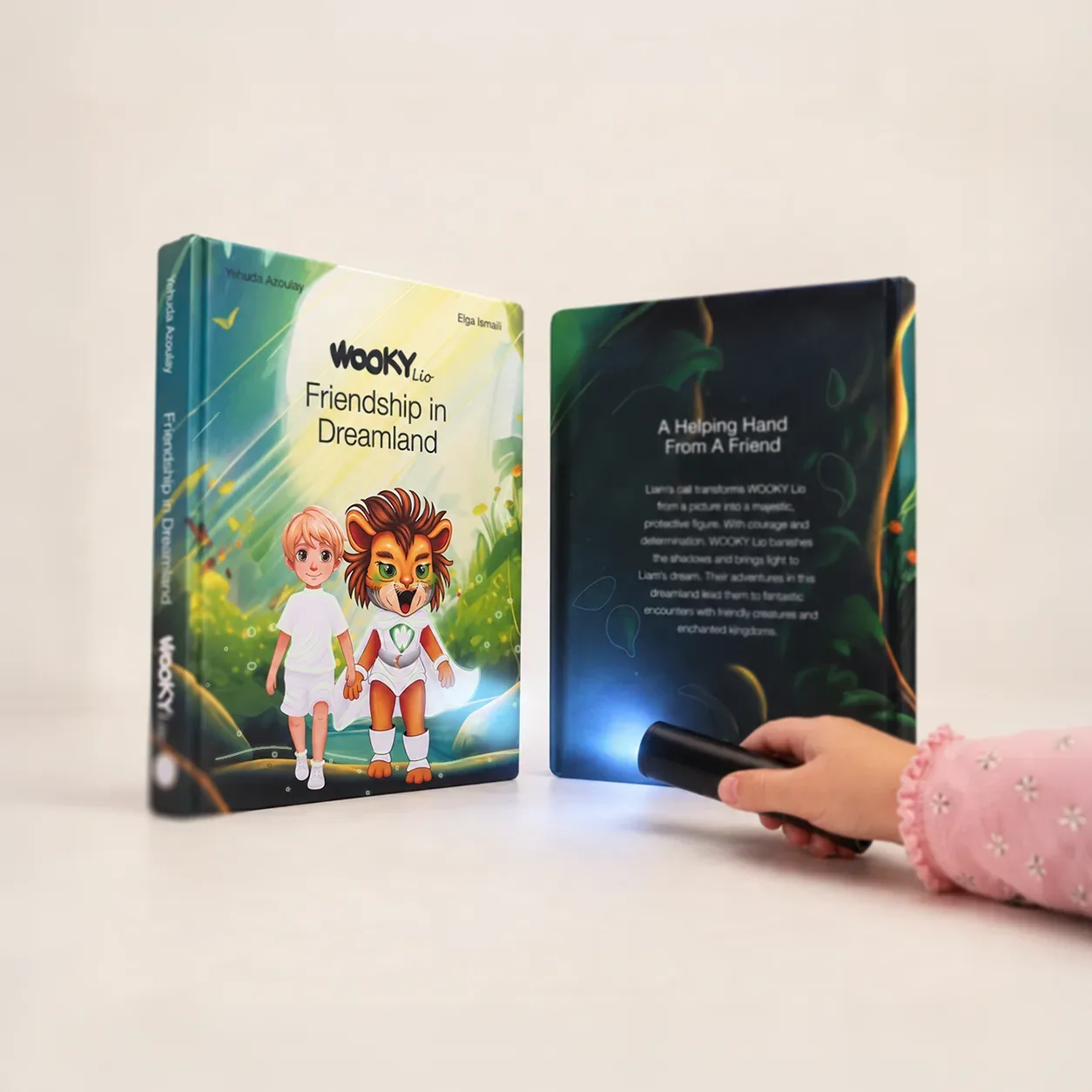
WOOKY Lio: Friendship in Dreamland - an interactive book that connects light with story
WOOKY Lio: Friendship in Dreamland was created from a simple idea: turn the moment the lights go out into the beginning of a new experience.
In normal light, children read the story and meet Lio and the world of Dreamland. When the lights are dimmed and the included UV flashlight is used, additional layers appear on the pages.
The discovery is not an external decoration added to the story. It is designed to make the child stop, search and feel that they are taking part in what is happening. The child holds the flashlight, the adult reads, and together they discover what is hidden inside the illustrations.
The set includes a hardcover book, a rechargeable UV flashlight and a charging cable. The combination of a printed book and the act of illuminating it creates an interactive experience that does not require a screen and allows the family to control the pace of reading.
How do you know the interactivity is really working?
A successful interactive book is not measured only by the first moment of surprise. You can tell the experience is working when the child:
- Asks to return to the book even after becoming familiar with it.
- Discovers more details with each reading.
- Asks questions that are not written on the page.
- Tells parts of the story themselves.
- Uses the characters in play outside reading time.
- Wants to show the book to someone else.
- Suggests a new way to read or play with it.
- Remembers the story, not only the effect.
The best mechanism is the one that opens a door into the story, not the one that captures all the attention for itself.
Mistakes worth avoiding when choosing an interactive book
Choosing only by the effect
An impressive effect can attract attention in a store, but it is worth checking whether there is also a story, characters and illustrations the child will want to meet again.
Ignoring the child's age
A book that is too complex can create frustration, while a book that is too simple can quickly lose its appeal.
Operating the book instead of the child
The adult does not need to perform every action and immediately show where every detail is. Part of the experience is allowing the child to try and discover.
Rushing to finish the plot
In an interactive book, pauses are part of reading. You do not always need to reach the end in the same evening.
Turning every activity into a learning task
A book can support development without making the child feel they are in a lesson. Enjoyment, imagination and connection are important goals in themselves.
Further reading
For more about shared reading, see Children's Books: How to Turn Story Time Into an Interactive and Unforgettable Experience. If you are looking for a gift idea, you may also enjoy Gifts for Kids - How to Choose a Gift That Creates an Experience and a Lasting Memory.
Frequently asked questions about interactive children's books
What makes a children's book interactive?
An interactive book invites the child to perform an action or influence the reading experience. The action can involve searching, choosing, guessing, movement, touch, illumination or participating in a conversation about the story.
Is an interactive book suitable for a child who cannot yet read?
Yes. Children can participate through illustrations, searching, actions and conversation even before they read independently.
At what age can you start using interactive books?
You can begin at very young ages as long as the activity, structure and materials suit the child. Toddlers benefit from simple actions, while older children can enjoy puzzles, choices and the discovery of more complex layers.
Does interactivity interfere with listening to the story?
Not when it is integrated well. Good interaction strengthens the connection to the plot. If the effect causes the child to ignore the story completely, it may be too intense or poorly integrated.
Can an interactive book replace regular reading?
There is no need to choose only one type. Interactive books and traditional books can live together on the same shelf. Each offers a slightly different pace and experience.
How do you read an interactive book with several children?
Divide roles: one child holds the book, another searches for a detail and another guesses what will happen next. Rotate roles so everyone has an opportunity to participate.
How should a UV flashlight be used with children?
Aim the flashlight only at the pages of the book, avoid shining it directly into the eyes, and use it with adult supervision, especially with younger children.
In conclusion
Interactive children's books are not meant to turn every page into a noisy game or fill reading time with effects. Their power lies in the ability to create a small invitation: come closer, look carefully, ask and discover.
When interactivity is integrated into a good story, it gives the child a natural way to participate. They do not need to know how to read in order to be part of the experience. They can point, guess, choose, shine the light, find a hidden detail or tell in their own words what they think is happening.
This participation also changes the adult's role. Instead of being only the person who reads the text, the adult becomes a partner in exploration. They listen to answers, respond to ideas and leave room for the story to unfold a little differently each evening.
That is the meaningful difference between a one-time effect and an interactive book that truly lasts. An effect surprises the child once. A good experience gives them a reason to return. During one reading the child focuses on the plot, during the next they search for a tiny character hidden in the illustration, and another time they invent a voice for a character or tell the story to a younger sibling.
Choosing an interactive book should still begin with the basics: a story that creates interest, characters children can connect with, illustrations that invite observation and quality that allows the book to be revisited many times. Only then is it worth asking what the mechanism adds and how it serves the experience.
In a book like WOOKY Lio: Friendship in Dreamland, the light is not simply an effect placed beside the story. It changes the way the child looks at the page. The child holds the flashlight, searches for the hidden layer and discovers that the illustration contains more than what was visible at first.
That moment can turn story time from something that happens in front of the child into something that happens together with them. And when a child closes the book but keeps talking about the characters, reenacting the discovery or asking to read it again the next day, the book has already done much more than tell a story. It has created a shared experience the child was part of.
Discover WOOKY
Meet WOOKY Lio: Friendship in Dreamland
An interactive children's book for ages 3-7 that invites children and grown-ups to read, shine, discover and experience the story together.
Explore WOOKY