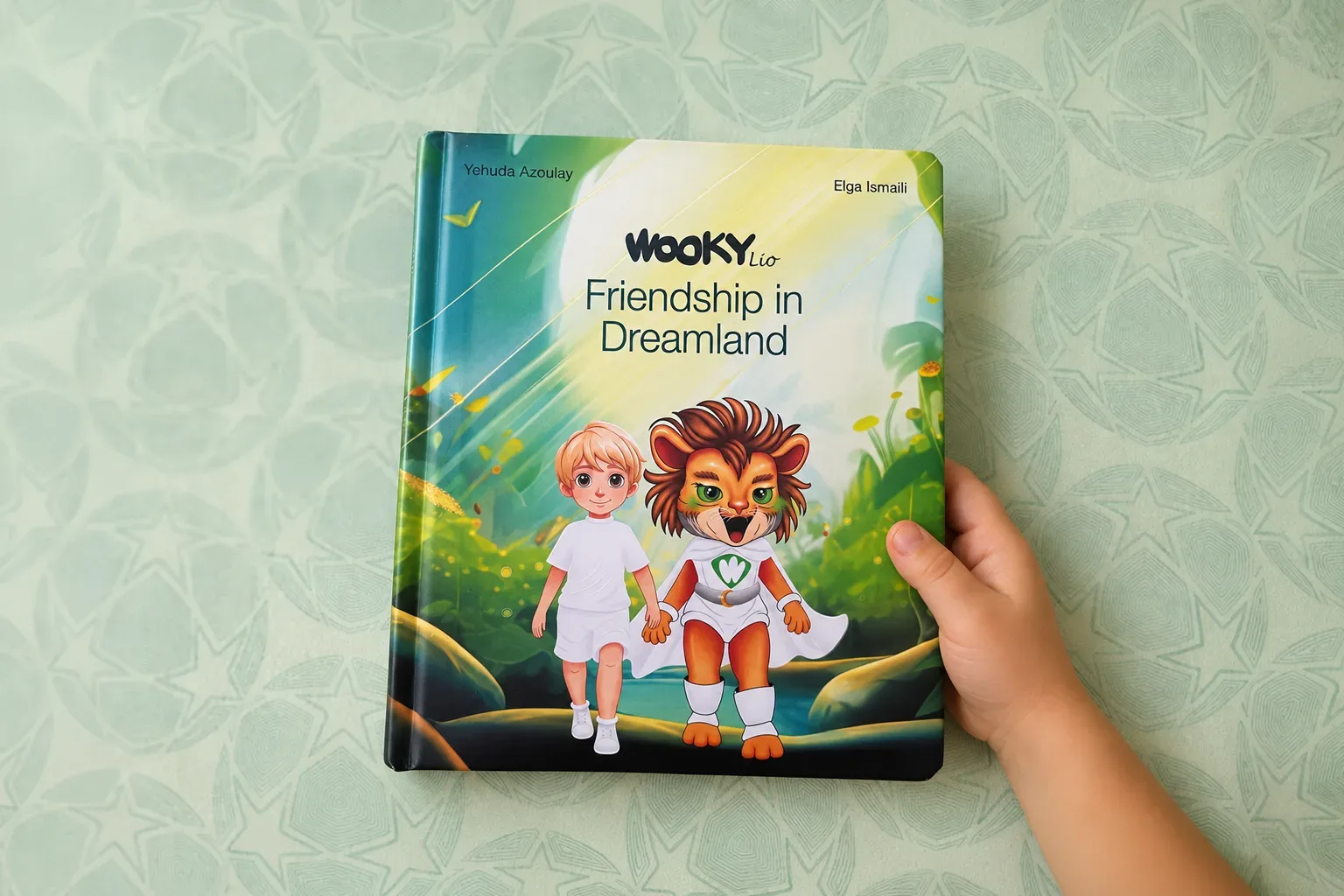
There is something special about the moment a child receives a new book.
Before the story even begins, before meeting the characters and even before opening the first page, the child meets the book itself.
They look at the cover. Touch it. Hold it. Open the book. Turn the pages.
For adults, a cover is sometimes seen mainly as the packaging around the content. For children, especially in early childhood, the physical encounter with the book can be part of the experience itself.
This is one reason a children's book with a padded cover can feel different from an ordinary book.
The cover is not only hard and durable. Beneath the outer material is a layer of padding that gives it a softer touch, a gentle sense of volume and a pleasant feel in the hand.
Technically, that may be a small detail. But in the world of children's books, where touch, color, illustration, imagination and story all come together, small details matter.
What is a padded cover?
A padded cover is usually a hardcover with a soft layer placed between the rigid board and the printed material that wraps it.
The result is a cover that keeps the structure and presence of a hardcover book, but feels slightly soft when pressed.
You can think of it as a combination of two worlds: on one hand, the structure of a hardcover; on the other, a softer and more pleasant tactile feel.
This construction is familiar from gift books, albums and special printed products, and it can work especially well for children's books in which the book itself is meant to be an object the child wants to hold, touch and return to.
Why invest in the cover of a children's book at all?
Because for a child, a book is not only text.
Children ages 3-7 experience a book through much more than reading or listening to words.
They look at the illustrations, point to characters, search for details, turn pages and hold the book close to them.
Sometimes they even return again and again to a specific page because one small detail in the illustration caught their attention.
In other words, a children's book is also a physical object.
And when its physical experience is pleasant and interesting, that experience can become part of the reading itself.
A padded cover does not turn an average story into a good story. But when the entire book is designed as an experience, the cover can be one more small layer that strengthens it.
A padded children's book versus a regular hardcover
From the outside, the two types of cover can look very similar.
Both can be thick, printed in full color and give the book more physical presence than a paperback.
The difference is felt mainly when you touch them.
A regular hardcover feels almost completely rigid.
A padded cover gives slightly under pressure.
The padding creates a softer feeling and adds a little volume to the cover.
In a book intended for young children, this difference can be especially noticeable because children do not only look at a book - they also explore it with their hands.
Touch is part of the way children discover the world
Young children learn through their senses.
They want to see, hear, touch, hold, move and try things for themselves.
That is why so many products for children combine tactile experiences - blocks with different textures, soft dolls, games with movable pieces and books that include different materials or tangible elements.
A padded cover is not a sensory game in itself, but it adds a subtle tactile quality to the book.
When a child picks up a book and feels that the cover is slightly soft, the book simply feels different.
Sometimes it is exactly these small things that make a product feel special.
A book that feels like something worth keeping
There are books we buy, read and pass on. And there are books that stay in the home for years.
They move from the shelf to the bed, from the bed to the living room, sometimes from the first child to a younger brother or sister, and in some cases they remain in the house long after the children have grown up.
A high-quality children's book can become part of a family's memory.
The cover is of course not the main reason for that. The story, the characters and the moments created around the book matter much more.
But when a book also feels well made physically, it is easier to treat it as something worth keeping.
Does a padded cover make a book more durable?
Here it is important to be precise.
The padding itself is not necessarily what makes a book more durable.
Durability depends on a whole combination of factors - the cover construction, materials, quality of gluing or binding, paper and the way the book is used.
The main advantage of a padded cover is first of all the tactile experience and the feeling it creates.
When it is built on a strong, high-quality hardcover base, the result is a book that feels both solid and pleasant.
And still, like any children's book, it should be treated as a book rather than a toy designed to be thrown or bent.
Why is it especially suitable for books for ages 3-7?
Between ages 3-7, children's relationship with books changes rapidly.
A three-year-old may sit beside a parent, listen to the story and point at illustrations.
Later, they begin to remember parts of the story, choose which book they want read to them and explain in their own words what is happening in a picture.
By ages six and seven, some children begin to recognize words, follow the text and develop greater independence in reading.
Throughout this period, the book moves again and again between the hands of the child and the adult.
That is why there is logic in a book that feels pleasant to hold and invites the child to come closer.
The cover is the first moment of the story
Before the story begins on page one, it has already begun on the cover.
The cover introduces the child to the world they are about to enter.
A character. A place. A color. A title. A small promise of what is waiting inside.
In a children's book, cover design has an especially important role because children respond immediately to visual imagery.
A padded cover adds a physical dimension to this first moment as well.
The child does not only see it. They feel it.
And so the first encounter with the book begins before it is even opened.
A high-quality children's book is built from many small details
When thinking about a children's book, it is easy to focus on two main things: the story and the illustrations.
But a physical book is an entire system.
There is the size of the book, the type of paper, the print quality, the colors, the typography, the cover, the weight, the way the pages open and the feeling of the book in the hand.
None of these details alone makes a book good.
But when they work together, they can create a more complete experience.
It is similar to a well-designed product - sometimes the user cannot explain exactly why it feels good, but they can feel that thought went into it.
A children's book is also a design experience
Children may not use words such as material quality, finish or user experience.
But they certainly respond to those things.
They know which toy feels pleasant to hold, which doll feels soft, which game attracts them and which book they want to take from the shelf again.
Good design for children does not need to shout that it is designed. It simply needs to work.
In a book, that means creating the right relationship between the content and the object that carries it.
What makes a children's book a special gift?
When buying a book for a child as part of everyday life, the content is usually the main consideration.
But when looking for a gift, additional considerations enter the picture.
We want the gift to feel special the moment it is opened, to create a sense of discovery, to look thoughtfully made and not disappear among dozens of toys after a few days.
A book with a padded cover can add the feeling of a gift book.
It can feel a little less like an ordinary printed product and more like an object meant to remain.
A gift for kids that does not end when the package is opened
One of the great advantages of giving a book is that the moment the child opens the package is only the beginning.
Then comes the first reading. Then the second. Then the third.
Later, the child already knows the characters. They know what is going to happen. They complete sentences, point to details and sometimes ask: again.
That is exactly the difference between a gift that creates one short moment and a gift that can become part of daily life.
What about an interactive book?
This is where things become even more interesting.
An interactive book adds action to reading.
The child is not only listening to the story.
They need to do something: search, open, touch, discover, illuminate, solve or make a choice.
Interactivity can appear in different ways, but the idea is similar - to turn the child from observer into participant.
When the physical book itself also receives special attention, the connection between touch, reading and action can create a richer experience.
A padded cover in a world of screens
Children today are surrounded by screens - phones, tablets, televisions and digital games.
Each of them can display animation, color, sound and movement at a level that is difficult for a printed book to compete with.
But perhaps a book does not need to compete with them.
The advantage of a book is precisely that it is physical.
You can hold it, feel it, turn a page by hand, move closer to an illustration and sit with it beside a parent.
A padded-cover book emphasizes this advantage in a small way.
It reminds us that a book is not only content. It is an object.
Do children really notice the cover?
They may not say, "I like the padding layer beneath the cover."
But children notice how things feel.
They feel that something is soft, that the book is thick, that the cover is smooth, that an illustration is glossy and that the pages feel different from another book.
Product experience is not always something we put into words.
Sometimes it simply creates the desire to touch again.
WOOKY Lio: Friendship in Dreamland - a book whose experience begins with the cover
When I created WOOKY Lio: Friendship in Dreamland, I wanted the book to feel special even before the child began discovering what was hidden inside it.
The book is designed for children ages 3-7 and combines a story, illustrations, characters and special UV-reactive colors that allow hidden details and layers to be revealed with a UVA flashlight.
But the interactivity is not the only reason thought also went into the physical product itself.
The book comes with a padded hardcover.
When you hold it, you immediately feel the subtle softness of the cover.
For me, that is part of the same idea: if you want to create a book a child will want to explore, the experience should begin before the first page.
A soft cover on the outside and a hidden world inside
There is something beautiful about this combination.
On the outside, the child meets a book that is soft and pleasant to touch.
Inside, they meet a world of colors, characters and story.
Then comes the flashlight.
When the pages are illuminated, additional layers that were there all along but could not be seen before appear.
This creates several stages of discovery: first you see the book. Then you hold it. Then you open it. Read. Illuminate. Discover.
Instead of giving the child the entire experience immediately, the book invites them to move toward it step by step.
Why do these details matter especially during story time?
Story time is not only a way to give a child information. It is a small ritual.
The child comes closer. The parent sits beside them. They open a book. Sometimes the lights are dimmed. Reading begins.
Within that moment, the physical feel of the book also becomes part of the experience.
A book that feels pleasant to hold can move from the parent's hand to the child's hand and become a natural part of the shared moment.
A padded-cover children's book as a gift for grandchildren
Grandparents often look for gifts for grandchildren that offer something beyond another toy.
A book can be especially interesting because it is not only a gift the child receives. It is also an invitation to do something together.
Sit. Open. Read. Ask questions. Discover things.
A book with a distinctive physical presence can strengthen the feeling that it was chosen thoughtfully.
And if the grandparent also reads it together with the child, the gift gains something that cannot be packed in a box: a shared memory.
How do you choose a high-quality children's book?
A padded cover is a nice addition, but it certainly should not be the only consideration. When choosing a children's book, it is worth looking at the whole picture.
Age suitability
The story, amount of text, language and illustrations should suit the child's developmental stage.
A story that creates interest
Children want to feel that something is happening. A relatable character, a question, an adventure, humor or discovery can make reading more engaging.
Illustrations that invite observation
A good illustration is not merely decoration around the text. It can add information, emotion and details the child discovers independently.
Physical quality
The cover, paper, printing and finish affect how the book feels and how it performs over time.
A reason to return
Maybe it is the story, the characters, details in the illustrations or the interactivity. A book a child asks to read again is a book that has created a connection.
Is a padded cover right for every children's book?
Not necessarily.
There are books for which a paperback is the right choice. There are board books for toddlers. And there are books for which a regular hardcover works perfectly.
A padded cover is not a standard of quality and is not a requirement for a successful children's book.
It is a design and product choice.
When the goal is to create a book with a distinctive, gift-like and slightly softer feel, it can be an excellent choice.
Is a padded cover suitable for young children?
For children ages 3-7, it can work very well.
The rigid structure gives the book a clear form, while the padding adds a sense of softness.
Of course, a padded-cover book is still intended for normal reading and handling, not for biting, folding or rough play.
At younger ages, shared reading with an adult is already an important part of the experience.
Does a padded cover make a book more expensive?
Producing a special cover can be more complex than producing a basic one, so it may affect manufacturing costs.
But for the reader, the more important question is whether that choice adds something to the product experience.
In a book designed to feel like a gift or a special experience, it can make sense to invest in details that are not part of the text itself.
A children's book does not have to be only a container for a story
You can think of a book as a container. There is a story inside it.
But you can also think of it differently - as a place.
A place where the child meets characters. A place they return to in the evening. A place where a parent and child spend a few minutes together. And a place where imagination gets time to work.
When we think about a book in this way, the materials, cover, illustrations and interaction also become part of the experience.
Further reading
To explore the subject further, you may also enjoy our article about books for young children, our guide to choosing gifts for kids, our article about interactive children's books, our article about bedtime story time, and our article about children's books with a UV flashlight.
Frequently asked questions about children's books with padded covers
What is a children's book with a padded cover?
It is a book whose cover includes a padding layer that gives it a softer feel. Usually the padding is combined with a rigid base, so the book keeps the structure of a hardcover while feeling slightly softer and more pleasant in the hand.
What is the difference between a padded cover and a regular hardcover?
A regular hardcover feels almost completely rigid. A padded cover includes a soft layer that adds a little flexibility and volume when pressed.
Is a padded cover better for children?
Not necessarily better, but it can add a pleasant tactile experience and give the book a distinctive, high-quality feel. The quality of the book also depends on the story, illustrations, materials and age suitability.
What age is a padded-cover book suitable for?
Suitability depends first on the content. WOOKY Lio: Friendship in Dreamland, for example, is designed for children ages 3-7, and the padded cover is part of the book's physical experience.
Is a padded cover more durable?
Not necessarily. Durability is determined by the book's construction, cover materials, production quality and how it is used. The padding is mainly intended to provide a softer, more distinctive feel.
Is a padded-cover book suitable as a gift for kids?
Yes. The physical feel and appearance of a padded cover can give the book the character of a gift book, especially when combined with a strong story, illustrations and a thoughtfully designed reading experience.
Does WOOKY Lio: Friendship in Dreamland come with a padded cover?
Yes. The book comes with a padded hardcover and also combines special UV-reactive colors with a 365nm UVA flashlight that reveals hidden details and layers during reading.
In conclusion - sometimes the experience begins before the first page
A good children's book is measured first by what it manages to create in the child.
Curiosity. Imagination. Emotion. A desire to continue. And a desire to return.
But a book is also an object the child holds in their hands.
That is why, when investing in a children's book, there is value in what happens before reading even begins.
A padded cover is a relatively small detail, but it can change the first encounter with the book. It adds softness to the rigid structure, gives the book a more distinctive feel and makes touch itself part of the experience.
In WOOKY Lio: Friendship in Dreamland, that idea continues inside the book as well.
The child meets the cover. Opens it. Enters the story. Meets the characters. Then gets the opportunity to do something more - take the flashlight, shine it on the pages and reveal layers and details that could not be seen in the same way before.
The result is a book that does not ask the child only to sit and listen.
It invites them to come closer, touch, look, search, ask and discover.
And ultimately, all of these details - the cover, illustrations, story, light and discovery - are designed to serve one much simpler thing:
To create a moment in which a child and an adult want to stay together inside the story just a little longer.
Discover WOOKY
Meet WOOKY Lio: Friendship in Dreamland
An interactive children's book for ages 3-7 with a UV flashlight, inviting children and grown-ups to read, shine, discover and experience the story together.
Explore WOOKY