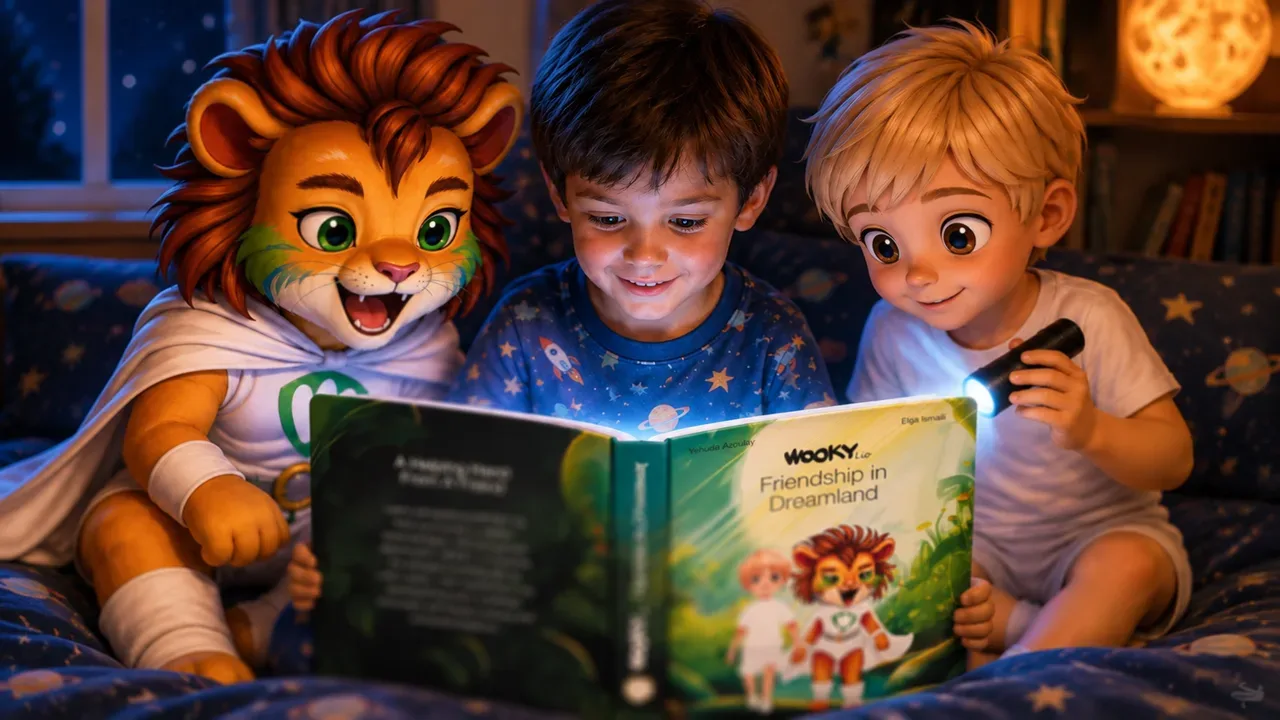
The room is already quiet, pajamas are on, and the child asks for one more story. Then the lights go out, a small flashlight comes on, and suddenly a world appears on the page that was not there before.
Children's books can be much more than text and beautiful illustrations. They can turn the minutes before sleep into a moment of curiosity, laughter, closeness and shared imagination.
In the early years of life, children do not simply listen to a story. They ask questions, point, complete sentences and ask to return to the same page again and again. That is why a good book is not measured only by its cover or by how many words it contains, but by what it manages to awaken - the surprised look, the question that is born in the middle of the plot and the memory that remains long after the book is closed.
Why are children's books family time, not just a story?
Reading together creates a family ritual. That ritual does not have to be long or perfect. Sometimes it is ten minutes on the sofa, and sometimes a short story in bed after a busy day. When the moment repeats itself, the child knows there is time devoted just to them.
Children from ages one to seven have very different needs. A toddler enjoys a familiar voice and the illustrations, a four-year-old is already looking for clues and hidden characters, and a six- or seven-year-old may want to talk about friendship, courage and fears. A book that allows each age to participate in its own way remains relevant for a long time.
There is also a quiet value that is hard to measure. During reading, there is no need to hurry. You can pause over an illustration, ask what a character is feeling, or laugh at a small detail discovered by chance. Unlike content that keeps moving on its own on a screen, a book allows the family to choose its own pace.
What do children really look for in a good book?
Children look for surprise - even when they already know the story by heart. They want to find a secret door, a tiny character hidden in an illustration, or a new detail they did not notice before. That is why books that encourage children to participate can hold their attention for a long time.
The child is not only a listener. They explore, ask, guess, tell and discover.
Participation can begin with a simple question such as "What do you think will happen now?" or "Where do you think she is hiding?" These small actions make the child feel that the story belongs to them too.
High-quality illustrations add another layer. They do not merely accompany the text, but tell an additional story - one that is sometimes revealed only on the second or third look.
When light reveals another layer of the story
There is a moment when a book stops being just a book and becomes an experience. Ultraviolet-reactive colors allow that moment to happen directly on the page. In normal light you see the story, but when you shine the flashlight, paths, stars, characters and clues that were previously invisible are revealed.
The magic is not only technological. The flashlight gives the child an active role. They decide where to shine it, what to look for and when to stop. In this way, curiosity becomes an inseparable part of the plot.
WOOKY Lio: Friendship in Dreamland is the first book ever to integrate ultraviolet-reactive colors as an integral part of the story.
The set includes a hardcover book, a rechargeable UV flashlight and a charging cable, so the experience begins from the moment the package is opened.
Unlike effects that appear in apps or on screens, here the discovery happens on the pages of the book itself. Every page becomes an invitation to explore, ask questions and discover more.
How do you choose a children's book that truly suits the child?
There is no single book that suits every child and every evening. Sometimes a child needs a short, calming story, and sometimes an adventure that leaves room for questions and laughter. The best choice begins with knowing the child, not only with a bestseller list.
Think about what attracts them right now. Children who love animals may connect with characters from nature. Children drawn to fantasy may look for worlds of moons, stars and dreams. A child dealing with a new friendship may find comfort in a story about feelings and relationships.
The recommended age is a starting point, not a rule. It is worth asking not only "Do they understand it?" but also "Do they want to return to it again?"
Physical quality matters too. A book intended for family reading should feel good in the hands and withstand repeated readings. A sturdy cover, clear printing and durable pages are not minor details.
Less screen time, more moments of discovery
Parents do not have to wage a battle against screens every evening. Screens are part of life, and they have good uses too. But before bedtime, many children and parents benefit from a slower transition - soft light, a familiar voice and imagination working without everything already being prepared for them.
An interactive book can give children the sense of discovery they are looking for without notifications, rapid pacing or an automatic jump to the next piece of content. The parent is beside them, the child asks questions, and together they decide whether to continue or stay a little longer with a detail that has appeared on the page.
Even five minutes of full attention can be more meaningful than half an hour in which everyone is looking at a different screen.
A gift that keeps opening long after the birthday
When looking for a gift for a child, it is easy to be drawn to what impresses in the first moment. But a good gift is one that invites repeated use and creates a shared experience. A book can be a very personal gift, especially when it offers the child not only a chance to listen, but to take part.
For grandparents, aunts and uncles, and family friends, an experiential book is a way of saying: we thought about your quality time together. It works for a birthday, a holiday or simply as a surprise for a child who loves discovering things independently.
Let the child lead the reading
One of the loveliest ways to get more out of a book is to let go a little of the need to read it the "right" way. You can let the child be the storyteller, choose a name for a character, guess what the character is dreaming about, or find three new details on every page.
When reading with ultraviolet light, you can pause and ask: what do you think will appear when we shine the light here?
The story does not have to end in the same place every time. Sometimes the child will invent an entirely different plot, and that is wonderful. When their ideas are welcomed, they learn that books are not only something that is read to them - they are a place where their own voice can live too.
Frequently asked questions
At what age should you start reading to children?
You can begin in the first months of life. At younger ages, the voice, rhythm and illustrations are just as important as understanding the plot.
What makes a children's book interactive?
An interactive book invites the child to participate through questions, searching for details, choices, actions or the discovery of additional layers in the story.
How should a UV flashlight be used with children?
Aim the flashlight only at the pages of the book, avoid shining it directly into the eyes, and use it with adult supervision, especially with younger children.
In conclusion
Story time is much more than reading words from a book. It is an opportunity to stop the rush of the day, create genuine quality time and give children memories that stay with them.
Ultimately, a good children's book is measured not only by the story it tells, but by the moments it creates - the smile that appears when an illustration is revealed, the question asked in the middle of the reading, and the hug before sleep. And if a book makes a child ask for "just one more page," it has probably done something right.
Discover WOOKY
Meet WOOKY Lio: Friendship in Dreamland
An interactive children's book for ages 3-7 with a UV flashlight, inviting children and grown-ups to read, shine, discover and experience the story together.
Explore WOOKY